Skip to content
Ostro

Genova

Book thirty minutes
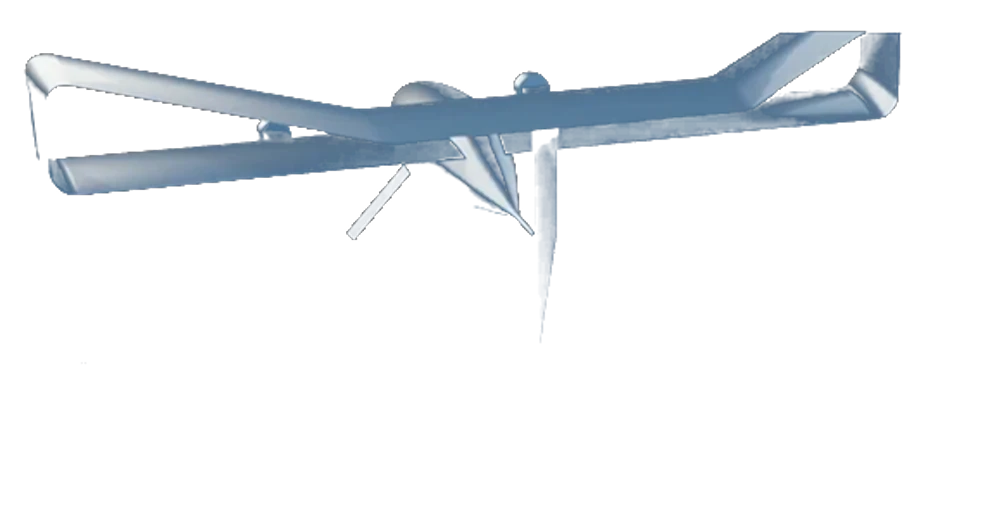
Render of the Boxy aircraft: closed box wing, pod-shaped fuselage, sensor window in the nose.

Fixed wing and propulsion · Genova

Fixed-wing aircraft that stay airborne for twenty hours.

Boxy: twenty-five kilos, three metres of span, series hybrid. The endurance calculation is closed, the airframe is on the drawing board, the first flight is the next thing we do.

20-22 hours[ assisted launch · without VTOL module · payload 4 kg · cap. 5.3 ]
25 kg[ takeoff mass · base configuration, without solar panels · cap. 5.2 ]
3 m[ wingspan · cap. 5.2 ]

Video Florian Delée · Pexels

01 · What has flown

One aircraft we have already built, and it flies.

Yellow and black fixed-wing aircraft in flight against an overcast sky, propeller spinning, ribs visible under the film.
The same aircraft on the ground in front of the UAS Challenge banner, with the logos of BAE Systems, Ansys and Leonardo.

Fixed wing, H tail, ribs visible under the film. We designed and built it ourselves inside DOPE Hubs, the University of Genoa student association. The aircraft belongs to the association, not to us: it is here as proof of what we know how to do.

1st[ Italian team · UAS Challenge 2026, Institution of Mechanical Engineers ]
10[ people on the team · University of Genova ]
6[ how many left to found Ostro ]

02 · What we are building

A box wing, and a module that comes off.
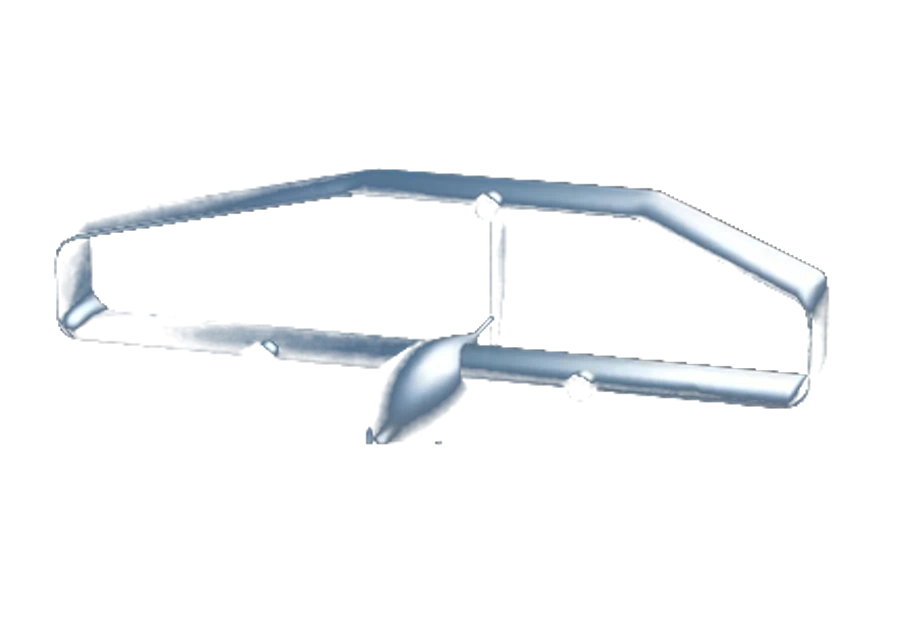
Render of the Boxy aircraft: closed box wing, pod-shaped fuselage, sensor window in the nose.

The twenty hours and the ten hours are the same aircraft. What changes is the vertical takeoff module: with it mounted you take off from a valley clearing or a ship's deck, and that mass is carried in cruise for the whole mission. Claiming the twenty hours without saying this would be convenient for us and useless for you.

10-1320-22 hours [ same airframe · VTOL module mounted · cap. 5.3 ] [ assisted launch · without VTOL module · payload 4 kg · cap. 5.3 ]
25 kg[ takeoff mass · base configuration, without solar panels · cap. 5.2 ]
3 m[ wingspan · cap. 5.2 ]

03 · The bay

The aircraft doesn't know what it's doing. The bay does.

Apennine ridge seen from above, woods and dirt roads, raking light.
Wildfire front at night, smoke lit from below by the flames.
Boxy in cruising flight seen from below, closed box wing and pod-shaped fuselage.
Boxy parked on a wet meadow, an operator beside it with a laptop open on the hood of an off-road vehicle.

Four kilos in the modular bay. Change the payload and the mission changes, the airframe stays the same.

Survey and mappingFires and searchTerrain modelConnectivity Ground images redone in the same shift, instead of days apart with the light changed. A fire front you can watch at night, and watch all night without swapping aircraft. Under the canopy, where optics stop at the leaves. A radio bridge that stays over the area for a whole shift, then flies back on its own.
4 kg[ payload in the modular bay · cap. 5.4 ]

04 · Endurance

How many hours do you need over the area?

6 hours

Multirotor, 25 kg
Boxy, with VTOL module
Boxy, no module

If you need half an hour over a construction site, buy a multirotor and you'll be right. This page is about full shifts.

Where these three numbers come from

05 · The trajectory

Colombo 3, and the real trajectory.

Altitude profile: powered ascent, inertial flight with airbrakes, apogee at 3000 meters, descent with drogue and then main parachute.

Drag to rotate the scene

Calculated first, measured after. Spin the scene with your finger and pick a phase.

M3100 engineEnd of thrustRight on altitude3000 mTwo parachutes A 5.5-meter rail, attitude 86 / 356 degrees. The burn lasts a few seconds. From here on the rocket climbs on momentum, and slows down. They open during the climb to reach the right altitude instead of overshooting it. The highest point above the field. That's where the first parachute comes out. First the drogue, to come down straight. Then the main one, opened low so we don't drift away from the field.

Curve reconstructed from the flight chart · Novi Ligure, south threshold of runway 18/36

06 · Before it flies

How we verify it before it flies.

CAD section of the vector's front part: the green lever that releases the parachute and the orange actuator that arms it.
Velocity field around the vector solved in Ansys Fluent, with the shock structures visible on the tail fins.
ActuatorRelease leversHatchParachute bay Arms the system on the ground. If it's not armed, the rocket doesn't launch. When the actuator lets them go, the hatch opens and the parachute comes out. It stays closed through the whole climb and opens all at once, at apogee. 3D printed and tested on the ground, opened and closed, before going inside the vehicle.
The finsThe wakeThe noseThe scale The shock structures you see here are the reason the tail is designed this way. Behind the nozzle the field closes back up, and the blue is nearly still air. Air hits here first. From this tip, the rest of the field follows. From blue to red, from zero to 489 meters per second. That's the maximum resolved in Ansys Fluent.

Tap the numbers on the drawing.

07 · Where we stand

Four things, and only one has already flown.

Velocity field around the vector solved in Ansys Fluent, with the shock structures visible on the tail fins.
Close-up of a woven-twill carbon fiber laminate.
Render of the Boxy aircraft: closed box wing, pod-shaped fuselage, sensor window in the nose.
High-altitude solar glider on a black background, solar cells on the wing and the propulsion unit's plate.
Colombo 3Serial hybrid chainBoxy's cellHALE 2 Colombo 3, the vector, with measured trajectory. The series hybrid chain: engine, generator, bus. Boxy's airframe, with the feasibility study closed and published. A solar wing that stays up for days instead of hours. It's the next step, and for now it's only a study.

The first-series bay isn't closed yet. Anyone talking to us now finds the interfaces still changeable.

Ten people in black t-shirts holding the Genova flag in a field, the yellow fixed-wing vehicle in front of them.

08 · Who builds it

Six people, and a yellow aircraft.

We come from the University of Genova team that won the Italian UAS Challenge. Six of us left, and founded Ostro inside Firmamento Technologies.

The names, one by one

The DOPE Hubs team at the UAS Challenge 2026, with the vehicle in front.

09 · Let's talk

Bring us a mission, we'll tell you if it flies.

The button opens your email with the message already written. We reply within one business day.

Thirty minutes, by video call or in Genoa. You tell us what you need to keep an eye on, for how many hours at a stretch and how often it repeats. We tell you whether our platform can reach it, and if it can't, we tell you what can.

If you'd rather write first: sebastiano.raggi@firmamentotechnologies.com. If you'd rather talk: +39 393 309 5657.

The feasibility study, 12 chapters, PDF, 15 MB, in full, without leaving your email.

10 · At the bottom

The sheets, and who signs.

The numbers and conditions The standard The price Support and data About us

Firmamento Technologies Società Cooperativa, Via Brigata Liguria 105R, 16121 Genoa. REA GE-528629. C.F. and P. IVA 03038500991. PEC firmamentotechnologies@pec.it. Privacy

The numbers on this page come from the feasibility study, with chapter and section noted under each one. The three material slabs are generated images. The aircraft, the CAD sections, the velocity field and the trajectory are not: they're ours.

This translation was made by machine. The Italian version is the authoritative one.